
Itawamba Projected Versus Actual Release
A projected date is a calculation made before the custody event. MDOC calls its public field “Tentative Release Date.” That wording matters. It may reflect sentence length, credit, earned time, classification, and other facts known when the record was calculated. An actual release date records the physical end of the identified custody episode. A release certificate or administrative release record is stronger proof of what occurred.
County and state records cannot be treated as one system. A person awaiting trial at the Itawamba County Detention Center may leave on bond, after a court order, or by transfer. No fixed date may exist. A person serving a short local sentence needs the jail's computation and commitment order. A person committed to MDOC can have separate ERS, tentative, and maximum release dates. A county departure for MDOC intake is continued custody, not state discharge.
Note: Name the date field exactly because booking, court, tentative, location-change, and physical-release dates answer different questions.
Find Itawamba Projected Release Dates
Start with custody type. The MDOC inmate search is appropriate for a person committed to Mississippi state custody. It accepts first name, last name, or MDOC ID. The ID reduces confusion caused by common names and aliases. The Itawamba jail and the relevant court remain the right sources for a county sentence or pretrial detention. BOP and ICE have separate systems and do not belong in an MDOC calculation.
- Confirm the person's full name, date of birth, booking number, or MDOC ID before matching a record.
- Determine whether the current custody is Itawamba County, MDOC, federal, immigration, or another county.
- For MDOC, open the matching detail and compare ID, birth date, descriptors, offense, and county of conviction.
- Read entry date, location, unit, location-change date, sentence length, and “Tentative Release Date” together.
- For a county sentence, ask the jail and court for the commitment order, jail credit, and local release computation.
- Request the current MDOC timesheet or computation when a state date needs a person-specific explanation.
- On the expected date, obtain the certificate or jail release record and verify whether the person entered other custody.
The detailed MDOC record can also list offense entries, sentence dates, number of sentences, total length, photograph, and county of conviction. Location may name an institution or community-corrections placement. It is not a universal “released” label. A search miss can mean the person was county-only or outside MDOC scope.
Identity checks matter when the date will be used to plan a call, visit, or pickup. Compare the MDOC ID and birth date first, then physical details and county of conviction. Note when the public record was viewed because a later computation can replace it. If the location names Community Corrections, ask whether that means parole, probation, ERS, or another placement. Do not rewrite a location clue as full discharge.
The image below comes from the official MDOC offender-search interface.
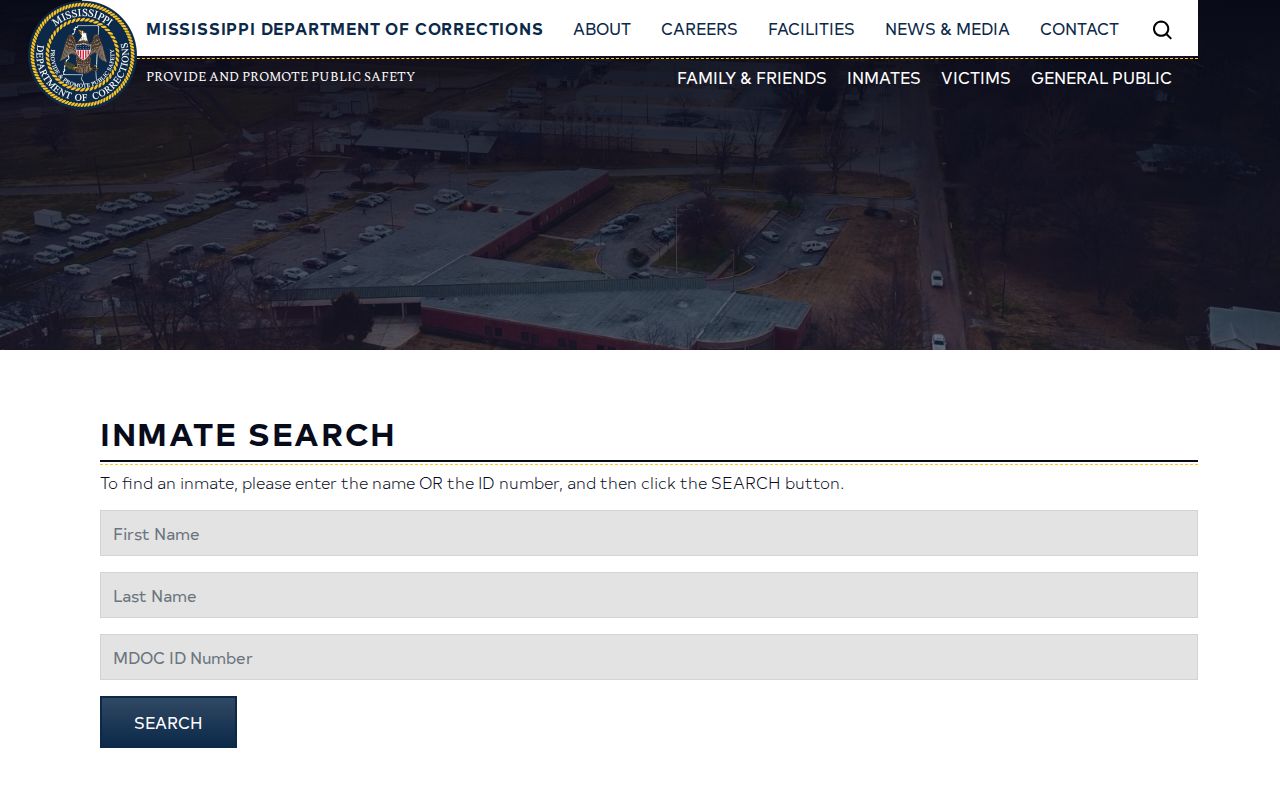
It confirms the name and MDOC ID inputs used to locate a state record before reading the tentative date.
Itawamba Earned Release Calculations
Miss. Code § 47-5-138 supplies the earned-release framework for qualifying MDOC sentences. For sentences imposed after June 30, 1995, subsection (5) provides 4.5 days of allowance for each 30 days served, capped at 15 percent of the sentence. This produces the familiar 85 percent description for an eligible sentence. It is not a promise that every state prisoner will be released after serving exactly that share.
Eligibility has limits. MDOC identifies exclusions that include life sentences, habitual-offender sentences, certain mandatory periods, sex crimes, escape or attempted escape, and earned time forfeited by the commissioner. Offense date, sentence date, the judgment, and the law that applies to that sentence all matter. Conduct and classification also affect the calculation. An approved in-state residence is required for ERS.
Subsection (6) says an eligible person released before expiration under this framework is on ERS and retains inmate status under MDOC jurisdiction. Under subsection (7), a revoked person's remaining term is served without credit for ERS street time. Earned release can therefore mean physical life in the community while the state sentence remains active.
Parole is a separate route. The State Parole Board may consider an eligible prisoner, but eligibility, a monthly list entry, a hearing, a favorable action, and physical release are distinct steps. Parole should not be calculated by subtracting 15 percent. The governing parole law, offense date, Board action, and MDOC processing must all be checked. When both a tentative date and parole issue appear, ask which authority each date reflects.
- ERS date
- The calculated point for possible Earned Release Supervision.
- Tentative release date
- MDOC's public projected date, subject to the current computation and status.
- Maximum release date
- The calculated end point before any separate lawful custody is considered.
- Jail credit
- Qualifying time in custody before state sentence entry that is applied to the proper cause.
Itawamba Release Computation Quirks
Pre-sentence jail credit is a major local link in an MDOC calculation. The MDOC handbook says eligible confinement must fall between the offense and earliest sentence date and concern the current cause number. Duplicate credit is not posted. MDOC seeks the credit from the county of conviction, and time spent in a different jail should be identified to the case manager. A missed or corrected credit entry can move the projected date.
Other events can change a date without making the earlier display false at the time it appeared. A court may amend a judgment. MDOC may restore or forfeit earned time. Classification can change. A residence plan can be approved or rejected. A detainer may cause release to another custodian. Parole may create another path, but eligibility or a hearing is not itself a grant.
| Factor | Possible effect | Best record |
|---|---|---|
| County jail credit | Moves the sentence-begin computation when qualifying time is posted or corrected | County certification and MDOC timesheet |
| Earned-time action | Adds, restores, or removes an allowance | Current MDOC computation |
| Amended court order | Changes sentence terms or credit | Signed order and revised computation |
| Residence or classification review | Can delay or alter ERS processing | MDOC case record |
| Parole action | Creates, denies, or defers a conditional release path | Official Board action |
| Detainer or hold | May change the destination from community to another custodian | Detainer and release certificate |
This is the Itawamba County computation quirk that matters most: the public page shows one tentative label while MDOC maintains several dates behind it. Ask which date is being quoted and when the calculation was last updated.
Detainers need special care. A person can reach the end of an MDOC custody step and then be delivered to another county, a federal custodian, or immigration authorities. The projected date may still mark the end of one state event, yet it does not establish a return to the community. Request the release method, detaining agency, and destination whenever another hold is possible.
Release preparation can also take time. MDOC says discharge processing may take 30 to 45 days and includes a discharge certificate. A case manager verifies travel plans, and MDOC may buy requested bus travel to the destination or nearest city, but not out of state. Those details explain why a tentative date is not a pickup time or travel promise.
Confirm Itawamba State Release Records
The representative MDOC detail below is linked from the official example record. It documents interface fields, not an Itawamba County person's history.
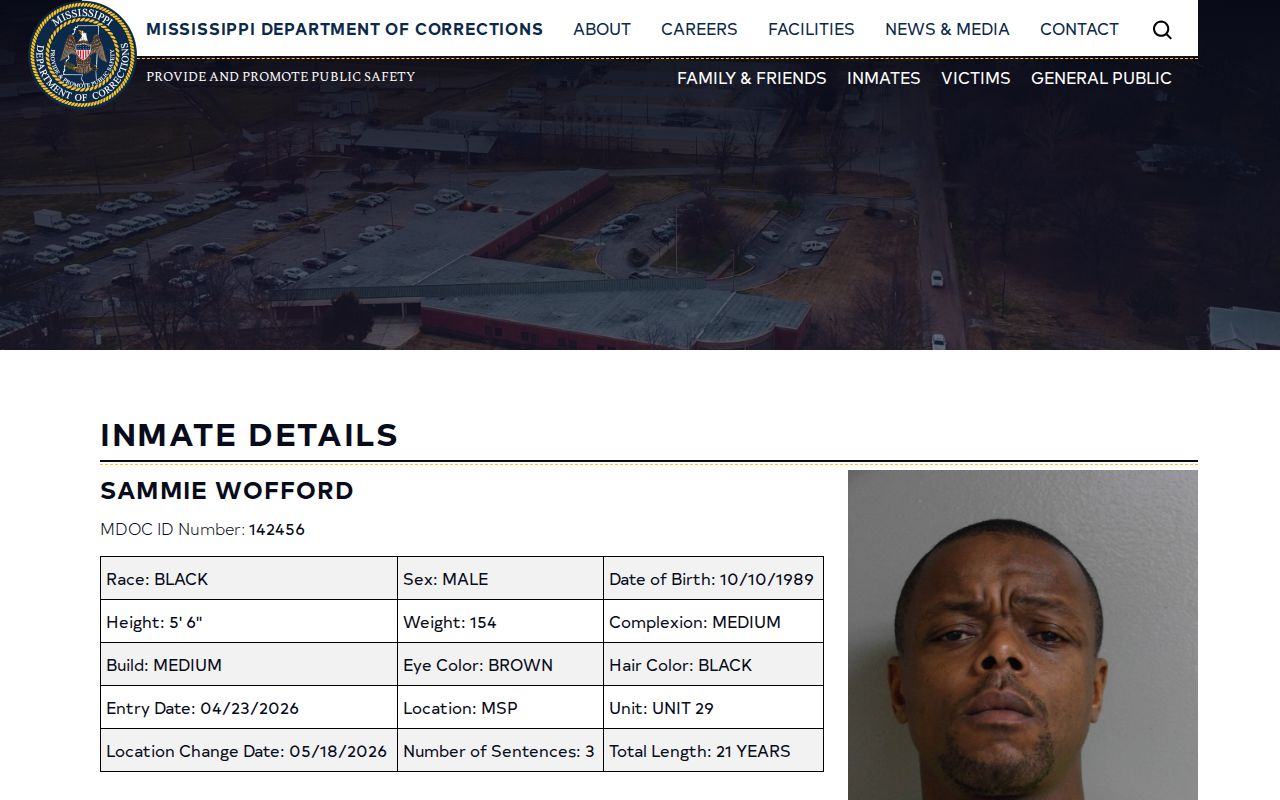
The screenshot shows why the exact “Tentative Release Date” label must be preserved and paired with current location and sentence facts.
MDOC Records can provide the stronger state path: PO Box 24388, Jackson, MS 39225; 601-933-2889; MDOCRecordsDepartment@mdoc.state.ms.us. Ask for ERS, tentative, and maximum dates; sentence begin date; time computation; pre-sentence jail credit; release method; certificate; and assigned supervision office as relevant. Use the person's MDOC ID and a narrow request.
A useful request states the exact question. If jail credit is disputed, identify the jail, dates, cause number, and county of conviction. If the public date changed, ask for the current computation and the record that caused the revision. If actual release is the issue, request the certificate and method rather than another copy of the projected date. This helps MDOC locate the record that answers the question.
For an Itawamba county sentence, request the commitment order and release calculation from the court and jail. Do not apply the state-prison formula automatically. For a pretrial case, ask what bond or court event could authorize release and whether another hold exists. The general Itawamba released-inmate record path explains how to pair the jail's physical-release record with the court order.
Confirm Itawamba Actual Release
On or after the tentative date, check the current MDOC location and obtain the discharge or release certificate. The certificate can show the method and whether supervision follows. If a detainer appears, confirm the receiving agency. “Released by MDOC” should not be expanded to “free from all custody” without that check.
Mississippi SAVIN can provide notice of a reported custody event. Its Registration Link may preserve an alert when a county person moves into MDOC custody. That is useful corroboration, but an automated transfer alert is not community release. The Itawamba VINELink check explains how to read and confirm the event label.
County confirmation follows a parallel path. The jail controls the physical release log, while the court controls the bond, commitment, amended sentence, or other order. Read both. A court date can precede jail departure because staff must process the order and check holds. The release log can show departure without explaining the final case result. Neither record should silently substitute for the other.
After the expected date passes, record what each source establishes. The MDOC certificate can prove the state release method and date. Community Corrections can verify an assigned supervision office when appropriate. A receiving custodian controls the next custody record. If the public detail still shows the prior location or tentative date, ask MDOC whether the page is awaiting an update instead of treating the mismatch as proof that release failed. A dated copy of the result helps explain what was visible when the check occurred.
Note: Release processing may continue after a date is calculated, so a projected date is not a guaranteed pickup time.