
Itawamba Post-Release Supervision
The Itawamba Probation & Parole Office is a field office of the Mississippi Department of Corrections. It is a reporting and supervision point in the community. It has no cells, booking roster, or jail release log. A person does not get “released from” this office in the same sense as leaving the Itawamba County Detention Center or a state prison. Instead, MDOC records may assign a person here after physical release or as part of a community-based sentence.
That distinction sets the right route. A county bond-out remains a county jail and court matter unless a supervision order applies. A state prisoner may leave an institution on parole or earned-release supervision and report to Community Corrections. A probation sentence comes from a court and may begin without a state-prison release. Full discharge means the named state status has ended, while physical release from a cell can occur much earlier.
| Status | Who authorizes it | Best record |
|---|---|---|
| Probation | Sentencing court | Sentencing order and MDOC supervision record |
| Parole | Mississippi State Parole Board | Board action and MDOC parolee record |
| Earned Release Supervision | MDOC under state law | MDOC computation and release certificate |
| Discharge | Responsible court or MDOC | Official discharge or completion record |
Itawamba Supervision Assignment
A person assigned to the Itawamba office generally lives in the community and reports under the terms of the applicable order. Office assignment may follow the approved residence rather than the county of conviction. It can also change after relocation or interstate transfer. For that reason, the office should be contacted only after an MDOC or court record points toward an Itawamba assignment.
The Mississippi State Parole Board decides parole. MDOC Community Corrections carries out supervision after release. Those are separate functions. The Board can confirm a nonexempt action or the status of parole consideration, while the local office addresses assignment and supervision information it may lawfully provide. MDOC Records handles sentence time, jail credit, release certificates, and state computation questions.
Verify Itawamba Supervision Status
Begin with the MDOC inmate and parolee search. The public interface accepts first name, last name, or MDOC ID. An ID is often the strongest search key. Open the matching result and compare birth date, physical descriptors, offense, county of conviction, and state ID. Read Location and any location-change date with care. A community placement can show ongoing MDOC jurisdiction rather than full discharge.
- Search the MDOC inmate and parolee interfaces by MDOC ID when known, or by the full name.
- Match the result with date of birth, county of conviction, sentence, and other identifiers.
- Read the current location or community-corrections clue and note the date viewed.
- For parole, request the official Board action. For probation, obtain the sentencing order.
- Contact the local office only after records indicate that Itawamba is the current assignment.
- Ask MDOC Records for a release certificate, computation sheet, or discharge status if the public label is unclear.
No public Itawamba recent-supervision feed exists. The office is not a substitute for the Tiger jail release list. It also is not a public named-person parole decision archive. The broader county search and record path is explained on the Itawamba County released-inmates home page.
Note: Staff may limit personal details even when they can confirm which office is responsible for a record.
Itawamba Supervision Office Contact
The official MDOC office page is the source for the local contact. Research identified Tony P. Harris as Community Corrections Director, but named assignments can change. The office address and number are the stable route to recheck current responsibility.
Itawamba Probation & Parole Office
109A Access Road
Fulton, MS 38843
Mail: PO Box 1693
Fulton, MS 38843
Phone: 662-862-4690
Fax: 662-862-4915
Ask a narrow question. State the person's full name, MDOC ID if known, and the official record that points to the office. A request to verify an assigned office is different from seeking a daily schedule or private case plan. For a parole decision, contact the Mississippi State Parole Board at 239 North Lamar Street, Suite 501, Jackson, MS 39202, phone 601-576-3520. For time and release records, contact MDOC Records at PO Box 24388, Jackson, MS 39225, phone 601-933-2889.
The published office page can also help distinguish this Community Corrections site from a prison. The captured official view below reflects the local supervision contact.
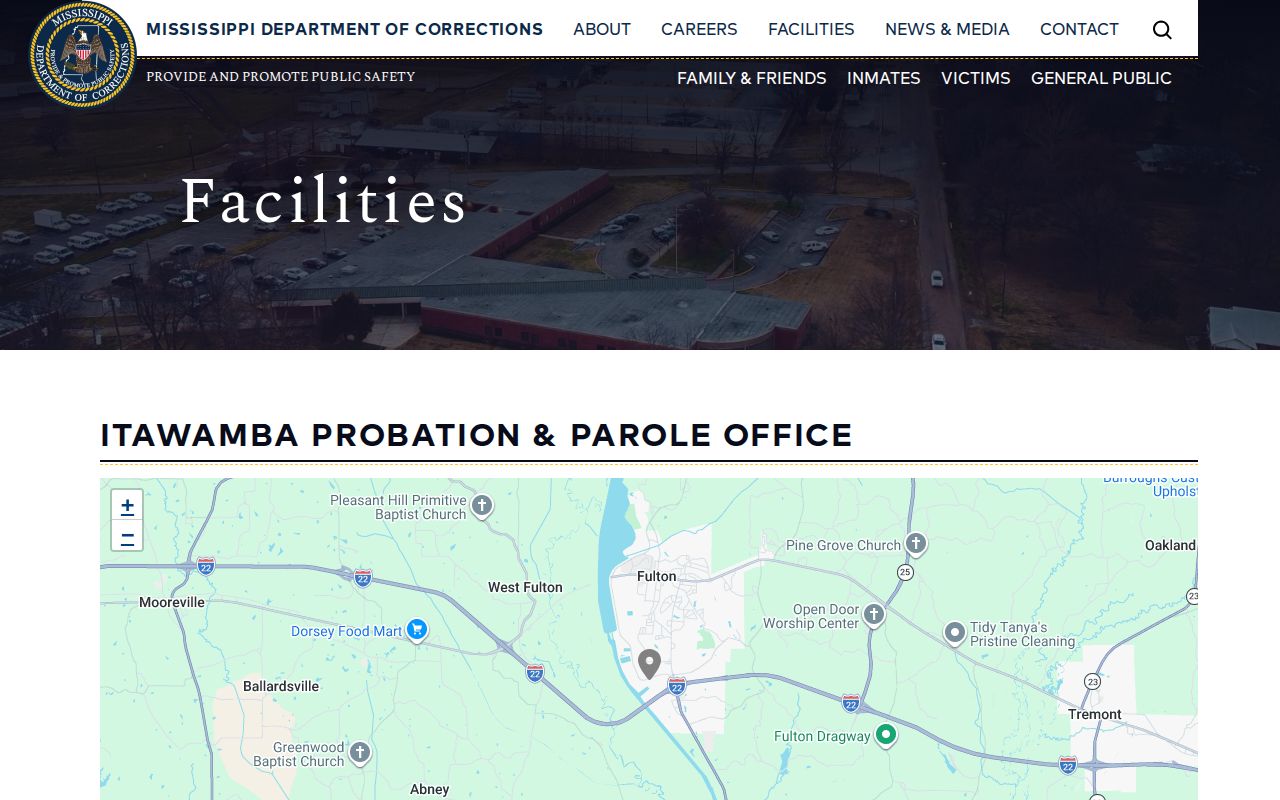
The office listing supports contact and assignment checks, but it does not certify the date a person left jail or state prison.
Itawamba Supervision Record Sources
Several records may be needed because each proves a different fact. A parole certificate or Board action identifies the conditional release decision. A probation order shows the court's sentence. An ERS computation shows MDOC's statutory community status. The release certificate proves the recorded state departure. A Community Corrections record identifies the assigned field office and current supervision category.
When requesting state material, give the name, MDOC ID, birth date, and a narrow date range. Ask for the actual release type and date, release or parole certificate, assigned supervision office, and discharge status. If sentence calculations matter, add the time computation sheet and jail-credit record. MDOC's public portal may show a “Tentative Release Date,” but that prediction is not a substitute for an actual release certificate.
- Parole
- Conditional release granted by the State Parole Board after eligibility.
- Probation
- A court sentence served under community supervision.
- ERS
- Earned Release Supervision, an MDOC status in which the person remains under state jurisdiction.
- Absconder
- A person alleged to have stopped complying with required supervision contact.
- Discharge
- The official end of the particular custody or supervision status.
Itawamba Absconder Record Limits
No county-published Itawamba warrant or supervision-absconder list was found. A missed jail roster result cannot be used to infer a warrant. An MDOC supervision issue belongs to Community Corrections and, where parole is involved, may also require a Board record. A court warrant belongs to the responsible court and law-enforcement agency.
The Mississippi Sex Offender Registry has separate compliance and absconder fields for qualifying registrants. It is not a general parole, probation, or release database. A registry hit addresses registry duties, and no hit says nothing reliable about ordinary supervision. Keep those systems separate when verifying an Itawamba post-release status.
If a record indicates revocation, distinguish the allegation, order, and custody result. Revocation can return a person to custody, but the local field office remains a supervision source, not a detention facility. Confirm present physical custody with the holding agency.
Ending Itawamba Supervision Records
Supervision ends through an official event, not merely because a public search stops showing a familiar label. Probation completion should be traced to the court or MDOC record. Parole discharge requires the proper state action. ERS remains an inmate status under MDOC jurisdiction through the relevant term, and revocation can affect how the remaining sentence is served.
A clean verification states both layers: whether the person is in a cell, and whether MDOC or court supervision continues. If the public result is uncertain, request the underlying state record. Never convert “not found” into “off supervision.” Spelling, old records, transfer, or an interface change can explain a missing result.
Parole processing has several steps. MDOC says an eligible-offender list is generated monthly and sent to the Board, but eligibility does not guarantee a vote for release. Even a grant can precede residence approval, detainer review, paperwork, and physical processing. The Itawamba office should not be asked to turn an eligibility date into a release promise. Request the Board action, then verify the MDOC certificate and current assignment.
Probation ends through the governing court and supervision record. The original sentencing order identifies the term, while later orders may change or revoke it. An office reassignment does not end probation. Likewise, completion of reporting at one location can reflect transfer to another office. Match any claimed end date to a signed order or MDOC discharge record and keep a copy of the exact status wording.
Note: Verify the assigned office again after any move because county of conviction and county of supervision may differ.
Itawamba Supervision Agency Routing
A precise supervision check depends on sending each question to the office that owns the answer. The State Parole Board controls parole consideration and its official action. MDOC Records controls sentence time, county-jail credit, release certificates, and state computation records. Community Corrections controls the assigned supervision office. The sentencing court supplies a probation order. A person may have records at several of these offices, but none should be treated as interchangeable.
Begin with the document already available. A Board grant should be followed by the MDOC release certificate and office assignment. A probation order should be matched to the MDOC supervision entry. An ERS record should be paired with the current computation because the person remains under MDOC jurisdiction. If an Itawamba office assignment cannot be confirmed, do not infer it from the conviction county. Ask MDOC which office currently holds the case.
For a county-jail departure that preceded supervision, obtain the Itawamba detention-center release record as a separate step. It identifies when county custody ended. The state or court record then identifies why community supervision began and whether it continues.