
MDOC Release Records Scope
Mississippi Department of Corrections institutions form a statewide prison and community-corrections system. Research found no MDOC prison within Itawamba County. An Itawamba resident can still enter state custody after a felony sentence and be housed elsewhere. The county jail departure to MDOC intake is a transfer. It is not a state-prison discharge and should not be reported as a return to the community.
The reverse distinction also matters. Someone who bonded out of the Itawamba County Detention Center or served a short county sentence may never have an MDOC record. Tiger and county records cover that event. MDOC is the correct custodian only when a Mississippi state commitment or state supervision status exists.
| Question | Correct system | Controlling proof |
|---|---|---|
| Did the person leave Itawamba jail? | County sheriff and court | County release log and order |
| Did MDOC custody end? | MDOC | Release or discharge certificate |
| Is state supervision active? | MDOC parolee search and Community Corrections | Assignment or supervision record |
| Was parole granted? | State Parole Board | Official Board action |
Search MDOC Release Records
The official MDOC inmate search accepts First Name, Last Name, or MDOC ID. Use the state ID when available. Name spelling, aliases, and suffixes can cause uncertain results. Open a likely record and compare the date of birth, physical descriptors, MDOC ID, offense, sentence, and county of conviction. An Itawamba conviction is a useful match point, but it does not show where the person is now.
- Enter the MDOC ID, or search the complete first and last name.
- Open the matching detail and compare identifiers before drawing a conclusion.
- Read entry date, location, unit, and location-change date together.
- Record the exact “Tentative Release Date” label without calling it an actual date.
- Check the separate parolee search for a community-supervision record.
- Ask MDOC Records for the certificate and computation when status remains unclear.
The screenshot below comes from the successful manifest capture of the official MDOC search. It shows the state route used for an MDOC-linked release.
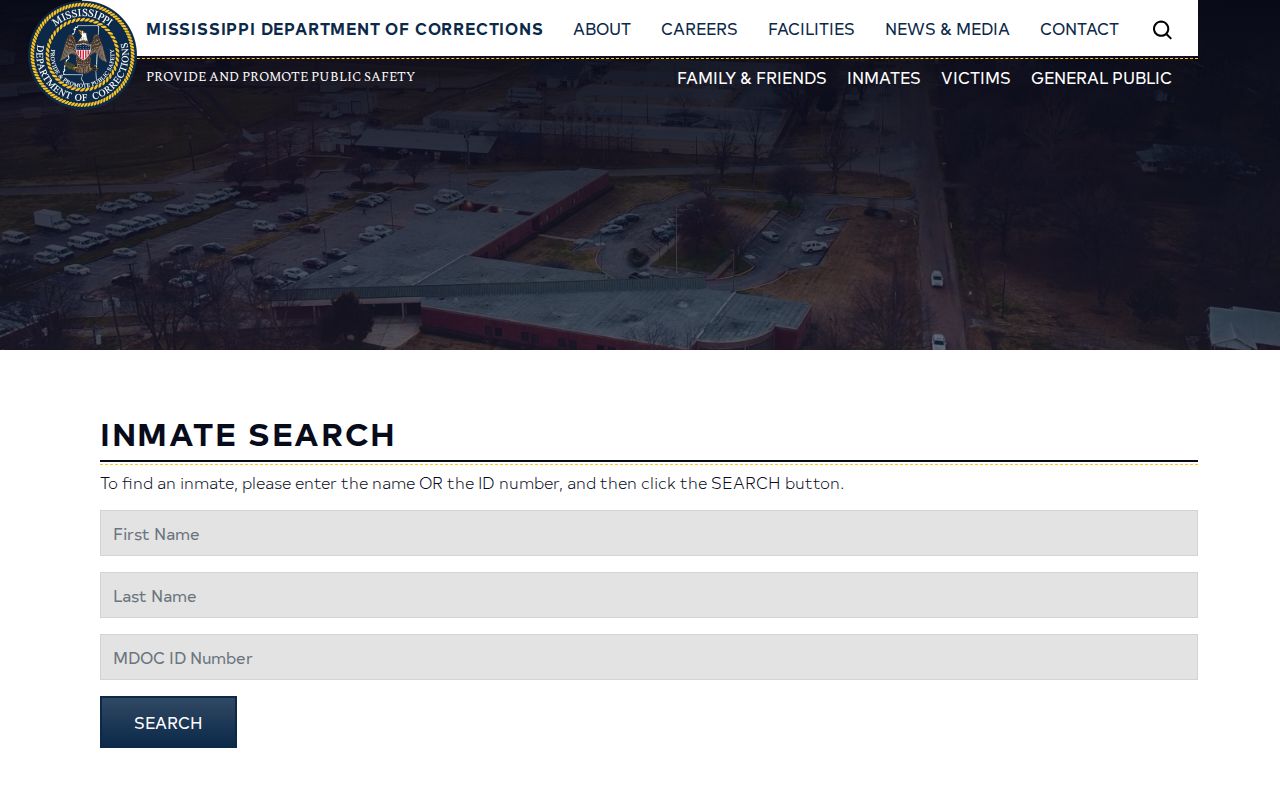
The search inputs start identification. The detail and state records establish the sentence and release layer.
MDOC Release Search Fields
The public detail may show a photograph, name, MDOC ID, race, sex, birth date, height, weight, complexion, build, eye and hair attributes, entry date, current location, unit, location-change date, sentence count, total length, offenses, sentence lengths, county of conviction, sentence dates, and Tentative Release Date. These fields help match the person and understand the state sentence.
Location is not a universal plain-language “Released” label. A community-corrections placement can mean physical release under continuing MDOC jurisdiction. A prison location points toward custody in an institution. A missing result may reflect a county-only case, a spelling problem, or a record outside the interface's scope. It does not prove discharge.
A representative official MDOC detail documented the interface labels. It is not an Itawamba person's record and should be used only to understand the fields.
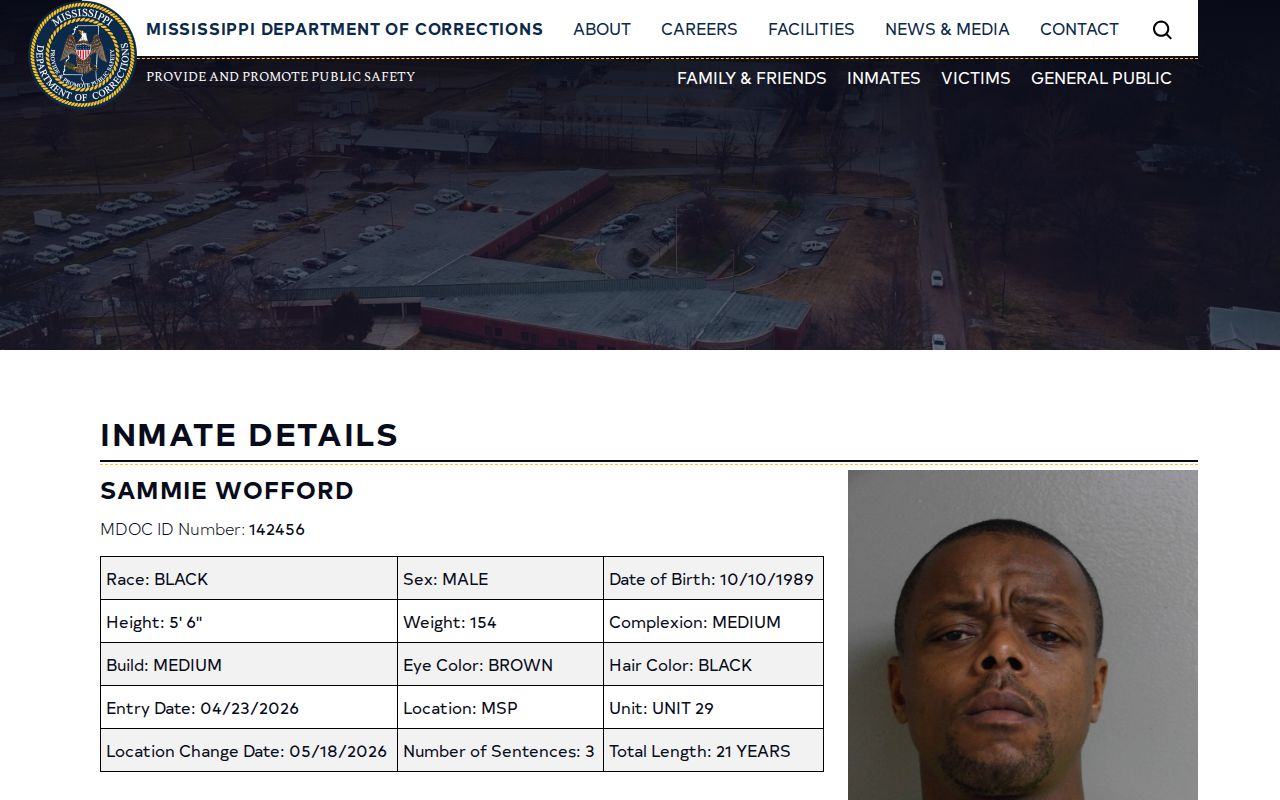
The captured record demonstrates why the exact date label and current location must be read together.
MDOC Release and Discharge Routes
A sentenced state prisoner may reach several different outcomes. Parole is conditional release granted by the Mississippi State Parole Board. Earned Release Supervision, or ERS, permits an eligible person to serve a portion outside a facility while retaining inmate status under MDOC jurisdiction. Sentence expiration or maximum release can end the custodial term. A transfer changes location without ending state custody.
MDOC calculates ERS, tentative, and maximum dates separately. Mississippi law permits an allowance of 4.5 days per 30 days served for some eligible post-1995 sentences, capped at 15 percent. That is the source of the common 85-percent shorthand, but it is not a promise. Offense and sentence dates, exclusions, conduct, classification, approved residence, jail credit, and detainers can change a person-specific result.
- Tentative date
- A current projected state date that can change.
- ERS
- Community placement while the person keeps inmate status under MDOC jurisdiction.
- Parole
- Conditional release based on a State Parole Board action.
- Maximum date
- The state computation endpoint, subject to the governing record.
- Detainer
- Authority that may send the person to another custodian at release.
Note: A future tentative date and parole eligibility are separate milestones, and neither proves that physical release has happened.
MDOC Release Records Contact
When a public detail does not resolve the status, ask MDOC Records for the actual state document. Identify the full name, MDOC ID, date of birth, and relevant period. Request the release or discharge certificate, actual date and method, assigned supervision office, sentence computation sheet, pre-sentence county-jail credit, and detainer or receiving-custodian information when pertinent.
Mississippi Department of Corrections Records
PO Box 24388
Jackson, MS 39225
Phone: 601-933-2889
Email: MDOCRecordsDepartment@mdoc.state.ms.us
MDOC's main office is at 301 North Lamar Street, Jackson, MS 39201, phone 601-359-5600. Questions about a parole decision go to the Mississippi State Parole Board, not the records unit. Questions about current local supervision go to the assigned Community Corrections office. These routes should not be merged because each office controls a different part of the state record.
The MDOC public-record portal linked from the agency's general-public page is another written route. Ask for existing records and a cost estimate. Narrow requests by state ID and date reduce confusion with similar names. The statewide record can confirm state release, but it cannot replace Itawamba County's physical departure log for the earlier county-jail transfer.
Itawamba MDOC Date Changes
Pre-sentence jail credit can affect the state sentence-begin date. MDOC's handbook says qualifying confinement must relate to the current cause number and fall within the eligible period. MDOC seeks credit from the county of conviction. If the person was held elsewhere, the case manager may need the name and dates of that jail. Duplicate credit is not posted.
Other changes may follow an amended judgment, credit correction, earned-time forfeiture or restoration, classification review, parole action, detainer, or approved-residence inquiry. An ERS release requires the state conditions that apply to that sentence. A current timesheet is therefore stronger than a saved public date viewed months earlier.
On the apparent release date, verify physical departure and obtain the certificate. Release processing can include travel review and documents. The MDOC release-processing information says case managers verify travel plans and that some requested bus travel may be purchased to the destination or nearest city, but not out of state. Those state-prison logistics do not describe a county bond-out.
Confirm an MDOC Discharge
A sound confirmation names the custody layer and document. First, verify identity in the offender detail. Second, check whether Location points to an institution or community setting. Third, compare the tentative date with the current computation. Fourth, obtain the release certificate and any Parole Board action. Finally, confirm whether supervision or another detainer followed.
A person can be outside a prison and still under MDOC jurisdiction. Conversely, a former county detainee may have no state record at all. For a named person's full county and state sequence, use the Itawamba County release search and records path. Keep the wording narrow: “released from MDOC physical custody,” “placed on ERS,” “paroled,” and “fully discharged” describe different facts.
When county-jail credit is disputed, obtain the dates from the jail that held the person and the cause number from the sentencing court. Compare those facts with the current MDOC timesheet. A county record can prove eligible confinement dates, while MDOC determines how credit enters the state computation. If a judgment is later amended, request the updated state calculation instead of relying on a prior screenshot.
The release certificate should identify the state event that actually occurred. Pair it with a Board action for parole, an ERS record for earned-release placement, or the receiving-agency document for a detainer. If the person moved to Community Corrections, verify the assigned office rather than presuming that Itawamba County conviction means Fulton supervision. Residence approval and interstate transfer can produce another assignment.
Mississippi SAVIN through VINELink can provide notice of custody changes for MDOC records, but an alert is corroboration rather than the state discharge certificate. A transfer event must remain labeled as a transfer. BOP and ICE locators serve different custodians and cannot verify a Mississippi state release.
Itawamba MDOC Release Packet
The strongest state verification is a small packet rather than one public field. Start with the matching MDOC detail and state ID. Add the current sentence computation, which can distinguish the ERS, tentative, and maximum dates. Add the actual release certificate or discharge record. If parole applies, add the official Board action. If community supervision follows, add the assigned Community Corrections office. A detainer or transfer needs the receiving-agency document as well.
This packet also resolves date conflicts. The Itawamba jail departure may mark transfer into MDOC, while the entry date begins the visible state episode. A later location-change date may reflect movement within state custody. The tentative date remains a prediction. The certificate identifies the processed event. Keeping those labels attached prevents a county transfer, a state community placement, and full discharge from being collapsed into one “release.”
For an Itawamba conviction, include the cause number and county-jail dates when requesting credit review. That gives MDOC a direct link to the sentencing and confinement records used in the computation.