
Itawamba Federal Custody Routes
Federal Bureau of Prisons and U.S. Marshals custody are systems, not an Itawamba County jail. Research found no physical BOP or USMS facility in the county. The U.S. Marshals Service says it owns no detention facilities and places most prisoners in state, local, or private facilities. That means an Itawamba roster entry may reflect a federal detainee held locally while a federal detention order remains in force.
A sentenced federal prisoner may later appear in the BOP Inmate Locator. A pretrial detainee can be released by court order, acquitted, transferred between contract jails, or designated to BOP custody after sentencing. Those paths produce different records. A departure from a local building does not by itself establish release from federal custody.
| Federal status | First source | Strong confirmation |
|---|---|---|
| Sentenced BOP prisoner | BOP Inmate Locator | BOP release record and federal docket |
| USMS pretrial detainee | Federal docket and holding jail | Release or detention order plus jail movement record |
| Local jail departure on federal hold | County destination record | Receiving federal custodian |
| BOP release to detainer | BOP locator and release notice | BP-A0714 and receiving-agency record |
Search Itawamba Federal Releases
Use the BOP Inmate Locator for a person who plausibly entered sentenced federal custody. The public data covers federal records from 1982 forward. Search by register number when known or by name and identity fields. A result may show name, register number, current age, race, sex, release date, and location. Compare all available identifiers before accepting a match.
- Choose register-number search when an official federal identifier is available.
- Otherwise enter the complete name and narrow the match with age, race, or sex.
- Open or read the matching row and record the release date and location exactly.
- Check the federal docket for the sentence, later order, or supervision terms.
- Request the BOP release record if a detainer, destination, or release method remains unclear.
The successful manifest capture below shows the official federal released-person search route.
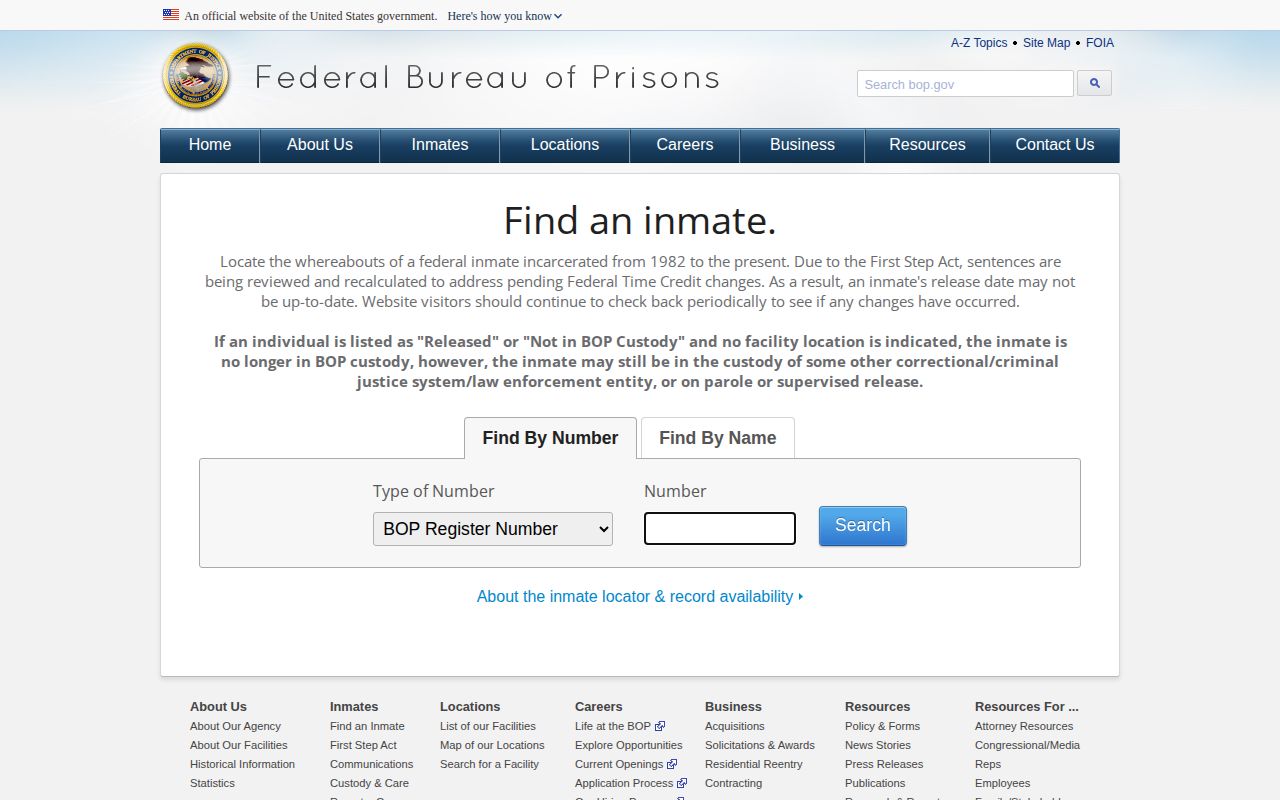
The locator can show that BOP custody ended, but it does not certify freedom from every other custodian or from federal supervision.
Interpret Federal Release Results
The BOP result should be read narrowly. A past Release Date with “RELEASED” or no institution is strong evidence that the person is no longer in BOP custody. It does not show every part of the route after release. The location field and federal docket may reveal whether the case involved a residential placement, a transfer, or another step. BOP data is extracted daily, so a newly processed change may not be immediate.
The BOP explanation of locator records describes the data's scope and update cycle. The related successful capture illustrates the limits that belong with any result interpretation.
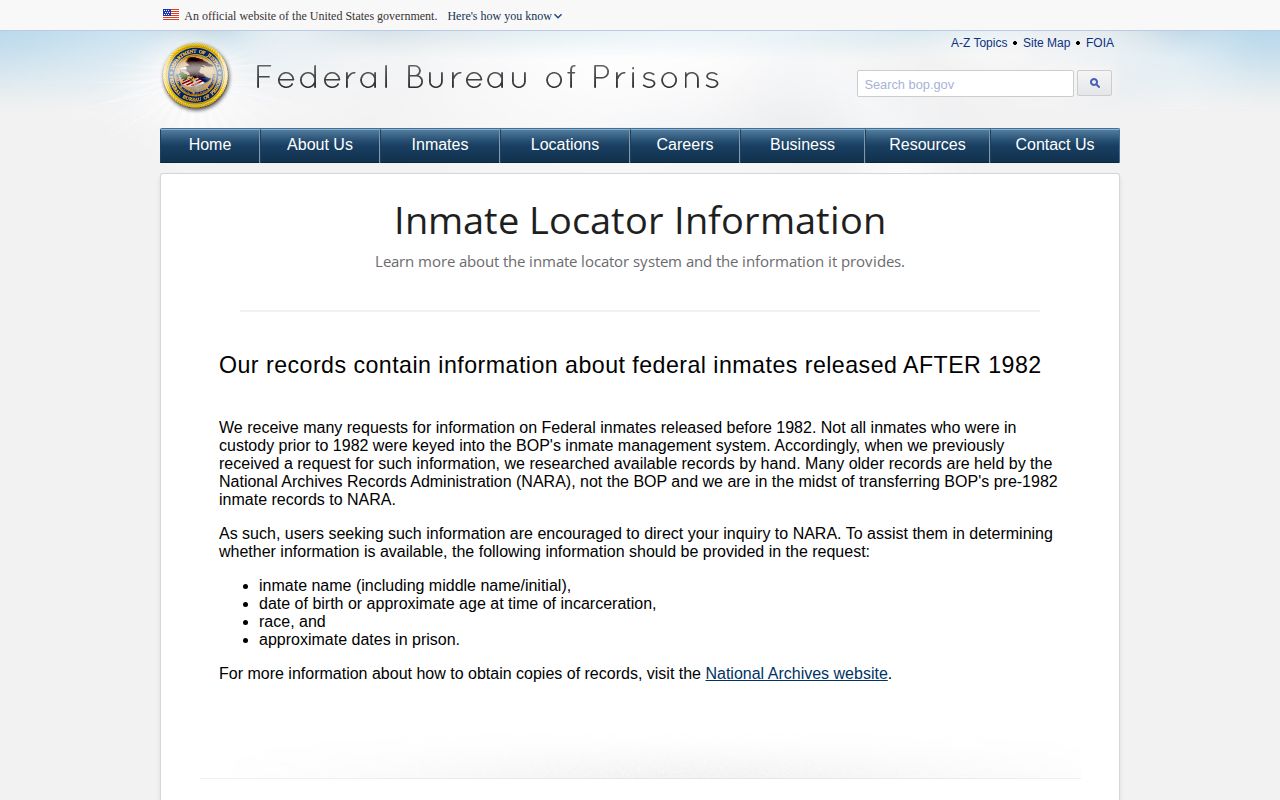
That source supports a careful statement about the end of BOP custody, not a broader claim that no court, detainer, or supervision remains.
- Register number
- The identifying number used to distinguish a federal BOP record.
- Released
- The locator's indication that BOP custody has ended.
- Detainer
- Authority for another custodian to receive or hold the person.
- Supervision
- Federal conditions in the community that may continue after prison custody.
Itawamba USMS Release Proof
The U.S. Marshals Service manages federal prisoner operations before and around trial, but it has no public historical locator comparable to BOP's. Its internal Prisoner Tracking System is restricted. A BOP no-hit therefore cannot prove that a USMS detainee was released. The person may never have entered a BOP institution, may be held under another identifier, or may still be in a contract jail.
For a pretrial case, start with the federal docket. Look for the detention or release order, later bond conditions, acquittal, dismissal, sentence, or remand. Remand means the court ordered the person back into custody. Then contact the actual holding jail for the physical departure record. The order shows legal authority; the jail record shows when the move occurred and where the person went.
The USMS prisoner-operations page confirms that federal custody often relies on nonfederal facilities. If Tiger or another local roster lists a federal agency, ask the Itawamba County Detention Center whether the person left for court, another jail, BOP designation, or community release. Do not report all four as the same event.
Federal Release Record Requests
The BOP Notice of Release and Arrival, form BP-A0714, can record the person's name, release date and method, institution, community or detainer destination, detaining agency, transportation destination and method, expected arrival, supervision agencies and contacts, proposed residence, and DNA status. It is a far richer source than a bare locator row when the receiving route matters.
Request BOP records through the agency's official records process and comply with identity or authorization rules. Ask for the release notice, calculation record, and documents that identify a detainer or transfer. Court filings belong with the federal court clerk. A contract jail's movement log belongs with that facility. Separating the requests makes each custodian answer the facts it actually controls.
Federal Custody Contact Route
BOP sentenced-prisoner records: BOP Inmate Locator and BOP records process
USMS pretrial status: federal docket and actual holding facility
Local confinement question: Itawamba County Detention Center, 662-862-7300
No BOP or USMS facility in Itawamba County
No local federal street address is listed because no federal detention facility was verified in Itawamba County. Presenting the county jail as a federal prison would be inaccurate. The federal agency controls the legal custody, while a local jail may only supply confinement space and the physical movement record.
Federal Release Date Computation
The BOP, not the county jail, computes a federal sentence. The computation can consider the federal judgment, prior-custody credit permitted by law, good-conduct time, and later court action. A projected or expected date can change. The official BOP sentence-computation resource is the right starting point for a federal calculation question.
Do not apply Mississippi MDOC earned-release rules to a BOP sentence. The state and federal systems use different laws, records, and agencies. Likewise, a federal supervised-release term is not Mississippi parole. The federal sentencing court and probation system govern those conditions.
On the displayed date, confirm that BOP processed the release and check whether the record names a detainer. If another agency received the person, obtain that custodian's record. A statement such as “BOP custody ended on the listed date” remains accurate without claiming that all custody ended.
Confirm Itawamba Federal Departures
When an Itawamba County roster entry has a federal link, record the booking number, arresting or holding agency, and any destination clue. Ask the detention center for the actual departure time and receiving authority. Then match that movement to the federal docket. If the person later entered BOP custody, use the locator and BOP release notice for the state-to-federal or jail-to-federal sequence.
A federal court order can precede actual processing. The holding jail may need time to check other holds and complete transport or release steps. Record both the order date and physical departure time without forcing them to match. If the jail transferred the person to another contract site, request that destination and continue the chain with the next custodian.
For a released BOP result, compare the locator's date with the sentencing docket and any later order. Then ask whether the release notice identified community placement, a detainer, or direct discharge. If supervision follows, the person can be outside BOP custody while still subject to federal court terms. That condition is distinct from Mississippi parole or MDOC Community Corrections.
A named-person county and federal search may require both systems. The Itawamba County release-record route explains how the local jail and court pieces fit together. BOP is not a substitute for Tiger, and Tiger is not a federal historical locator.
Note: Keep “left the Itawamba jail,” “left USMS custody,” and “left BOP custody” as three distinct conclusions unless records prove each one.
Itawamba Federal Release Packet
A complete federal confirmation often requires three records. The federal docket supplies the court's detention, release, acquittal, dismissal, or sentencing authority. The actual jail supplies the physical movement time and destination when USMS used contract space. BOP supplies the locator result and release notice after a sentenced commitment. The records may carry different dates because legal authority, transport, designation, and physical departure are separate steps.
For a USMS episode, request the local movement record with the federal case number and booking period. Ask whether the person left for court, another contract facility, BOP designation, or the community. Then compare the answer to the docket. A BOP no-hit does not resolve this stage because a pretrial detainee may never enter the sentenced-prisoner system.
For a BOP episode, preserve the register number and date searched. Request BP-A0714 when release method, detainer, transport, or destination matters. If the notice names another custodian, continue with that agency. If it identifies community release, check the federal docket for any supervision term. This evidence supports a limited, accurate statement about the federal custody that ended.