
Itawamba Parole and Probation Differences
Parole, probation, and earned release supervision describe different forms of control in the community. The Mississippi State Parole Board may grant parole after a state prisoner becomes eligible under the law. A court imposes probation as a sentence or part of a sentence. MDOC Community Corrections performs the day-to-day supervision for both. Earned Release Supervision, often shortened to ERS, is another MDOC status. An eligible person may serve an earned part of the term outside a prison while still retaining inmate status under Mississippi law.
A physical release is therefore not the same as discharge. Discharge means the relevant custody or supervision term has formally ended. An Itawamba County jail release on bond may involve no MDOC supervision at all, while an MDOC parole or ERS release can place the person in the community under continuing state authority.
| Status | Who authorizes it | Best confirming record |
|---|---|---|
| Parole | Mississippi State Parole Board | Board action and MDOC parolee record |
| Probation | Sentencing court | Sentencing order and Community Corrections status |
| ERS | MDOC under statutory rules | MDOC computation and release certificate |
| Discharge | Agency or court controlling the term | Final discharge or satisfaction record |
- Parole
- Conditional release from a state prison term after Board approval.
- Probation
- A court-ordered sentence served under conditions in the community.
- ERS
- Earned Release Supervision, an MDOC status in which inmate status continues outside a facility.
- Absconder
- A person alleged to have stopped reporting or left supervision without authority.
Verify Itawamba Post-Release Supervision
The public starting point is the MDOC inmate and parolee search. Its parolee interface accepts first name, last name, or MDOC ID. An ID is the strongest search key. Name searches can miss suffixes, aliases, and spelling variants. Open the possible match and compare the displayed biographical details before using the result. A county-only bond release or short county sentence may never create an MDOC record.
- Search the MDOC parolee interface by MDOC ID when known, or by the most complete name available.
- Match the result with date of birth, physical descriptors, offense, and county of conviction. Do not rely on the name alone.
- Identify the supervision label. Separate parole, probation, ERS, and a prison or community placement.
- For parole, request the official Board action. For probation, obtain the sentencing order from the proper court.
- Verify the assigned Community Corrections office. Residence or an interstate transfer can place supervision outside Itawamba County.
- Ask MDOC Records for a computation, certificate, or discharge record when the public label does not resolve current status.
A missing result is not proof that supervision ended. The person may be outside the public search scope, entered under another name, supervised elsewhere, or associated only with a local court file. The full Itawamba County release path on the released-inmate search and records page helps separate a county jail event from an MDOC release.
Match the legal source to the claimed status. A parolee record should be reconciled with the Board's action because the Board makes the parole decision. A probation claim should be checked against the sentencing order because the court imposed it. An ERS claim calls for the MDOC time computation and release certificate. These records can resolve whether state authority continues after the person leaves a secure facility. If systems use different dates, ask whether one marks a decision, another processing, and a third physical departure.
Note: Verify both identity and supervision category before treating a public result as the status of a particular person.
Itawamba Parole Office Verification
Itawamba County has a local MDOC Community Corrections field office. It is not a jail, a public release list, or the agency that votes on parole. It handles local supervision functions for people actually assigned there. An Itawamba conviction does not ensure an Itawamba assignment because residence, approved placement, and interstate transfer can change the responsible office.
The official MDOC office page is the source for its current location and contact data. Ask whether the office is the proper routing point for the person and what nonexempt status it can confirm. Avoid requesting private schedules or residence details.
Itawamba Probation & Parole Office
Street: 109A Access Road
Mail: PO Box 1693
Fulton, MS 38843
Phone: 662-862-4690
Fax: 662-862-4915
The image below comes from the MDOC local office listing.
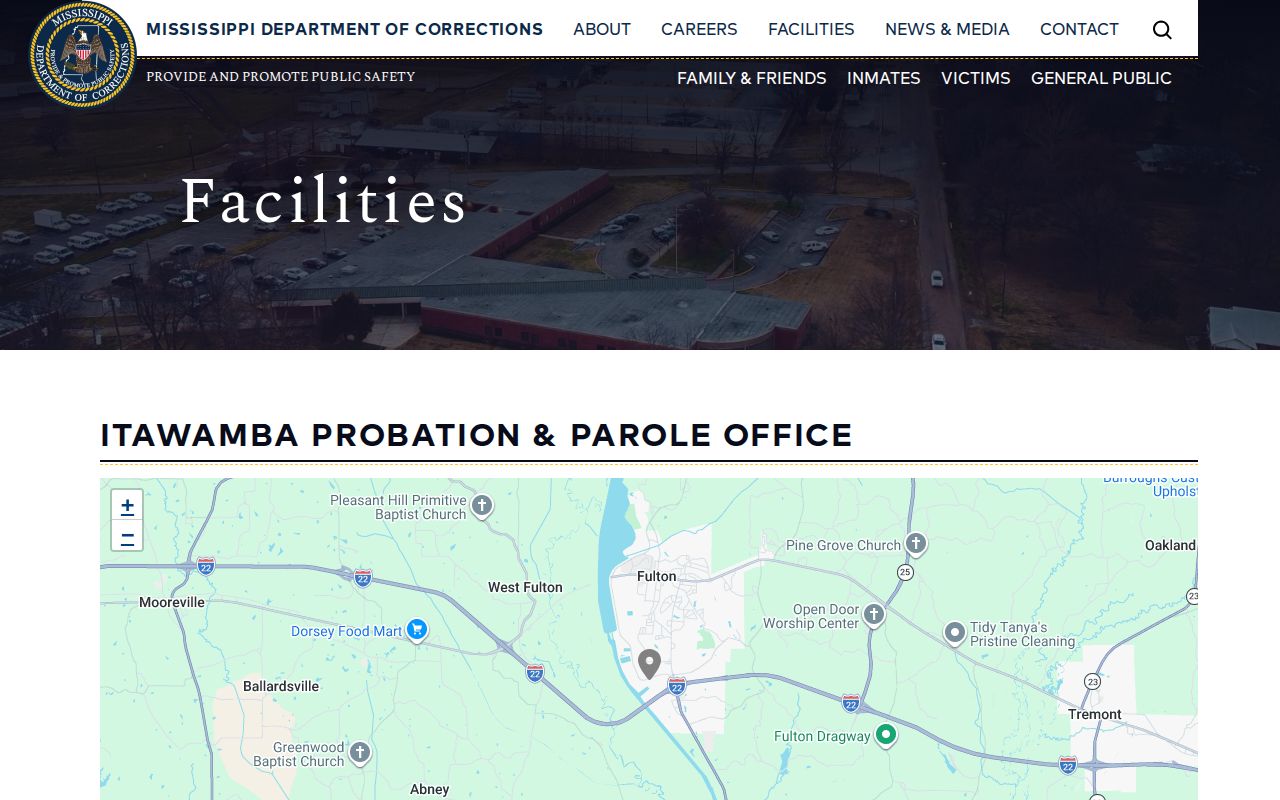
It shows the official state source to use when confirming the office rather than assuming an assignment from county of conviction.
Itawamba Parole Actions and Hearings
The Mississippi State Parole Board decides whether parole is granted or denied. MDOC reports that a list of eligible offenders is generated monthly and sent to the Board. Eligibility only means the person may be considered. It is not a hearing result, a grant, or proof that the person has left an institution. A favorable action may still be followed by residence review, paperwork, detainer checks, and physical release processing.
No official public named-person hearing calendar, decisions search, or actions archive was verified in the research sweep. A person-specific inquiry should go to the Board at 239 North Lamar Street, Suite 501, Jackson, MS 39202, 601-576-3520, or MSStateParoleBoard@mdoc.state.ms.us. Request the hearing date and official action or order. Possible outcomes include grant, denial, or deferral, with rescission or revocation possible later. Only the official record should be used to label an outcome.
The Board answers decision questions. MDOC Records answers sentence time, jail credit, and date-computation questions. Community Corrections answers appropriate supervision questions. These roles should not be merged.
Miss. Code § 47-7-5 creates the Board, while parole eligibility is principally governed by § 47-7-3 and offense-date-specific amendments. The 2021 Earned Parole Eligibility Act helps explain the history of the rules, but it cannot replace the current law and sentence file in a named case. Offense, offense date, sentence, and exclusions can alter the result. A percentage quoted without those facts is not a safe release prediction.
When requesting a Board record, provide the full name, MDOC ID, and enough case detail to distinguish the file. Ask for the official action, its date, and the outcome. If the action is a grant, confirm whether residence approval, detainer review, or processing remains. If it is a denial or deferral, custody ordinarily continues unless another lawful release route applies.
Itawamba Supervision Violations and Warrants
Supervision conditions come from the court order, Board action, certificate, and applicable MDOC rules. They can address reporting, approved residence, travel, treatment, payments, and lawful conduct, but the actual terms must be read from the person's record. A violation allegation may lead to review, a warrant, arrest, or revocation. It does not establish the final outcome on its own.
An absconder claim needs the same care. A Community Corrections absconder issue concerns supervision. The Mississippi Sex Offender Registry separately uses compliance or absconder labels for registration duties. A registry label does not automatically prove an MDOC parole or probation warrant. No county-published Itawamba warrant or absconder list was verified, so a roster no-hit must never be turned into such a claim.
Mississippi SAVIN may report custody changes tied to a participating agency, but it is a notification path rather than a parole-decision archive. An alert may state transfer, return to custody, escape, or another coded event. Save its exact wording and agency, then check with Community Corrections or MDOC. A county roster is narrower still and cannot show whether a person kept each supervision appointment after release.
Note: A return-to-custody event can end physical freedom without resolving the underlying supervision case or court proceeding.
When Itawamba Supervision Ends
Supervision ends through a formal act, not through silence in a public search. A probation term may end under the sentencing order or a later court entry. Parole concludes under the controlling sentence and Board or MDOC record. ERS remains an MDOC inmate status through the statutory term unless it is changed or revoked. Miss. Code § 47-5-138 states that ERS street time does not count after revocation, which is one reason a projected end date can move.
Ask for a discharge, satisfaction, or completion record that identifies the term and date. For parole, preserve the Board action and MDOC certificate. For probation, preserve the court order and the Community Corrections record. If the person had more than one case or custodian, one discharge does not necessarily end every hold or sentence. State the scope with care.
A complete statement might say that MDOC supervision ended on the date shown by a discharge record. It should not claim that every court obligation or separate custody matter ended unless those records also establish it.
Records may be requested from MDOC Records at PO Box 24388, Jackson, MS 39225, 601-933-2889, or MDOCRecordsDepartment@mdoc.state.ms.us. Use the MDOC ID, birth date, supervision type, and a narrow range. Request the release or discharge certificate, assigned office, and time computation only as needed. For probation, the sentencing court can supply the order and later entries. Each agency then addresses the record it creates.
More than one term may remain active. A person can finish parole in one case while probation continues in another, or complete state supervision while a separate court matter remains open. Review each cause number and sentence. When a record says “discharged,” identify the agency, term, and case it covers. That wording avoids turning a limited discharge into a claim about every legal obligation. It also helps the local office and court clerk locate the right file if a completion date needs correction.
Keep a copy of the final order or certificate. Public search labels can change after the term closes, while the originating record preserves the scope and effective date of discharge.